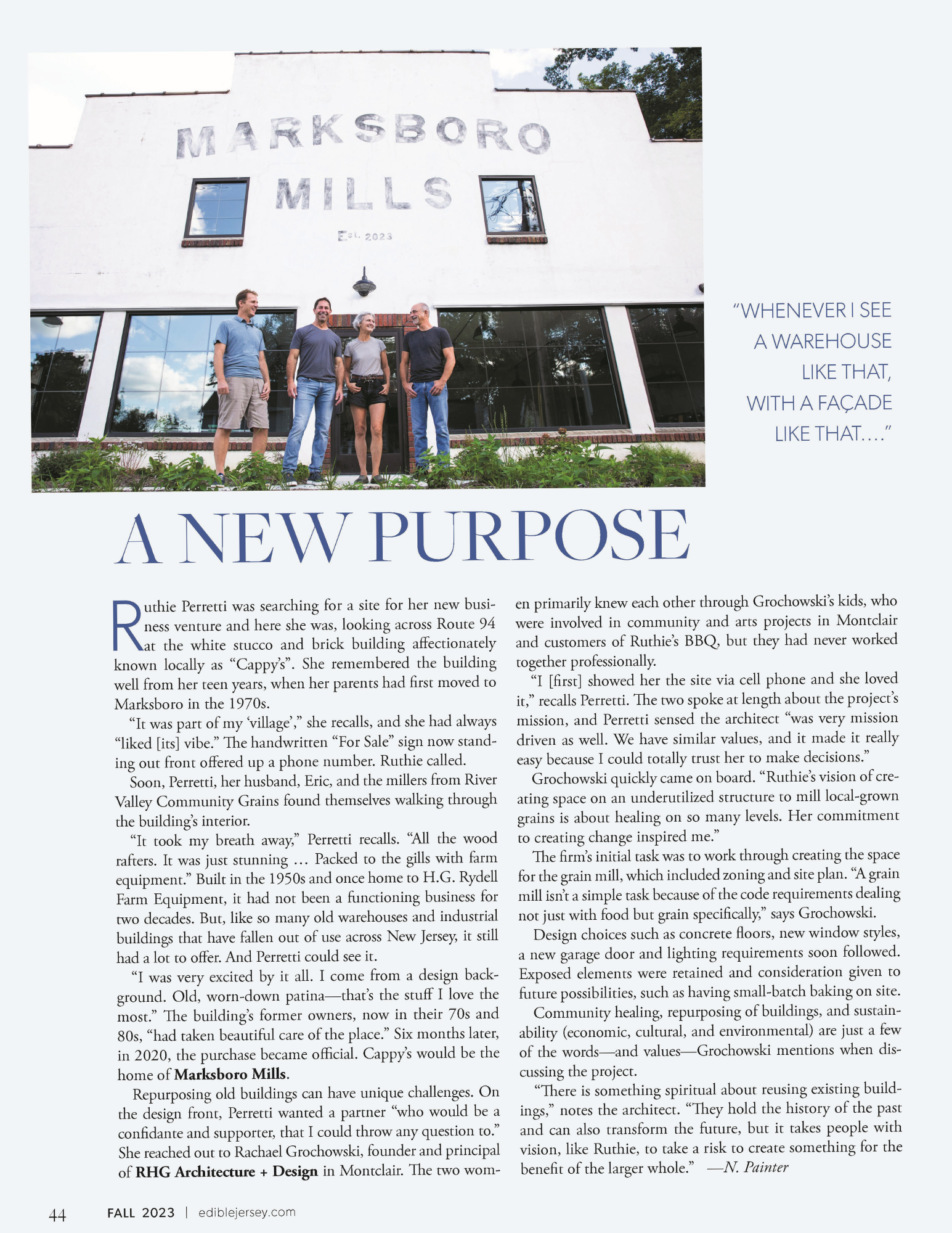
A NEW PURPOSER uthie Perretti was searching for a site for her new busi-ness venture and here she was, looking across Route 94 at the white stucco and brick building affectionately known locally as "Cappy's". She remembered the building well from her teen years, when her parents had first moved to Marksboro in the 1970s."It was part of my 'village'," she recalls, and she had always "liked [its] vibe." The handwritten "For Sale" sign now stand-ing out front offered up a phone number. Ruthie called.Soon, Perretti, her husband, Eric, and the millers from River Valley Community Grains found themselves walking through the building's interior."It took my breath away," Perretti recalls. "All the wood rafters. It was just stunning Packed to the gills with farm equipment." Built in the 1950s and once home to H.G. Rydell Farm Equipment, it had not been a functioning business for two decades. But, like so many old warehouses and industrial buildings that have fallen out of use across New Jersey, it still had a lot to offer. And Perretti could see it."I was very excited by it all. I come from a design back-ground. Old, worn-down patina-that's the stuff I love the most." The building's former owners, now in their 70s and 80s, "had taken beautiful care of the place." Six months later, in 2020, the purchase became official. Cappy's would be the home of Marksboro Mills.Repurposing old buildings can have unique challenges. On the design front, Perretti wanted a partner "who would be a confidante and supporter, that I could throw any question to." She reached out to Rachael Grochowski, founder and principal of RHG Architecture + Design in Montclair. The two women primarily knew each other through Grochowski's kids, who were involved in community and arts projects in Montclair and customers of Ruthie's BBQ, but they had never worked together professionally."I [first] showed her the site via cell phone and she loved it," recalls Perretti. The two spoke at length about the project's mission, and Perretti sensed the architect "was very mission driven as well. We have similar values, and it made it really easy because I could totally trust her to make decisions."Grochowski quickly came on board. "Ruthie's vision of cre-ating space on an underutilized structure to mill local-grown grains is about healing on so many levels. Her commitment to creating change inspired me."The firm's initial task was to work through creating the space for the grain mill, which included zoning and site plan. "A grain mill isn't a simple task because of the code requirements dealing not just with food but grain specifically," says Grochowski.Design choices such as concrete floors, new window styles, a new garage door and lighting requirements soon followed. Exposed elements were retained and consideration given to future possibilities, such as having small-batch baking on site.Community healing, repurposing of buildings, and sustain-ability (economic, cultural, and environmental) are just a few of the words and values Grochowski mentions when dis-cussing the project."There is something spiritual about reusing existing build-ings," notes the architect. "They hold the history of the past and can also transform the future, but it takes people with vision, like Ruthie, to take a risk to create something for the benefit of the larger whole." N. Painter