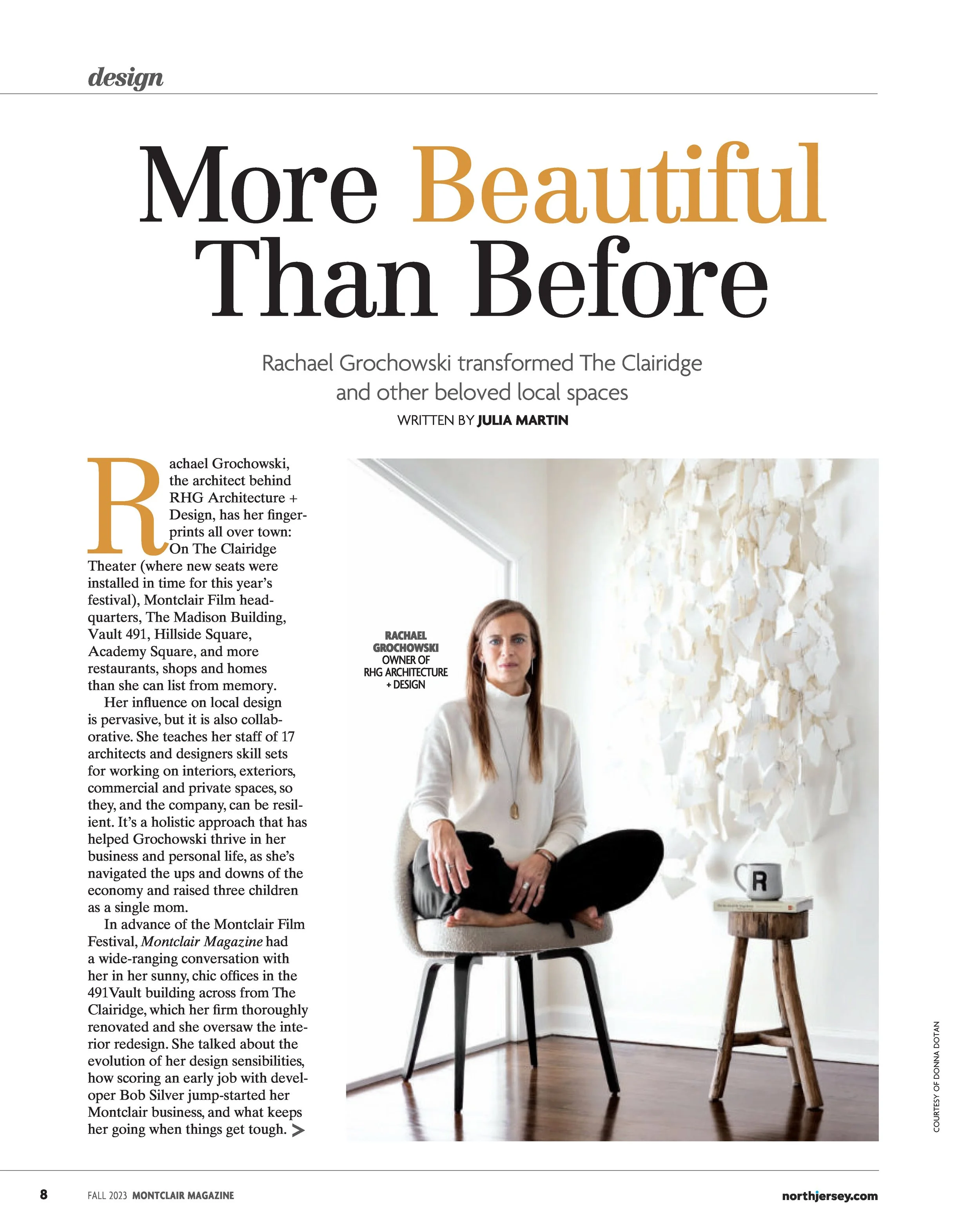
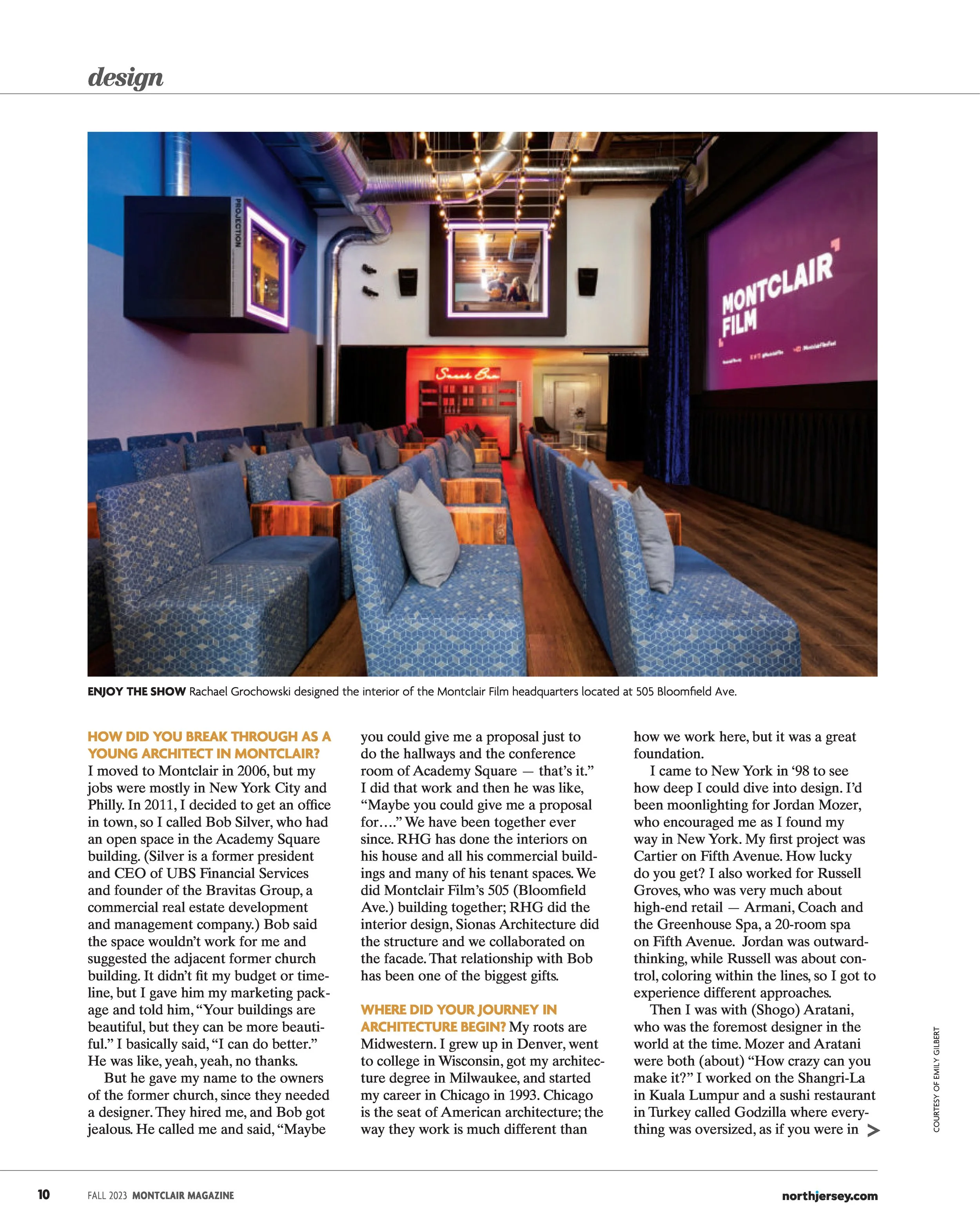
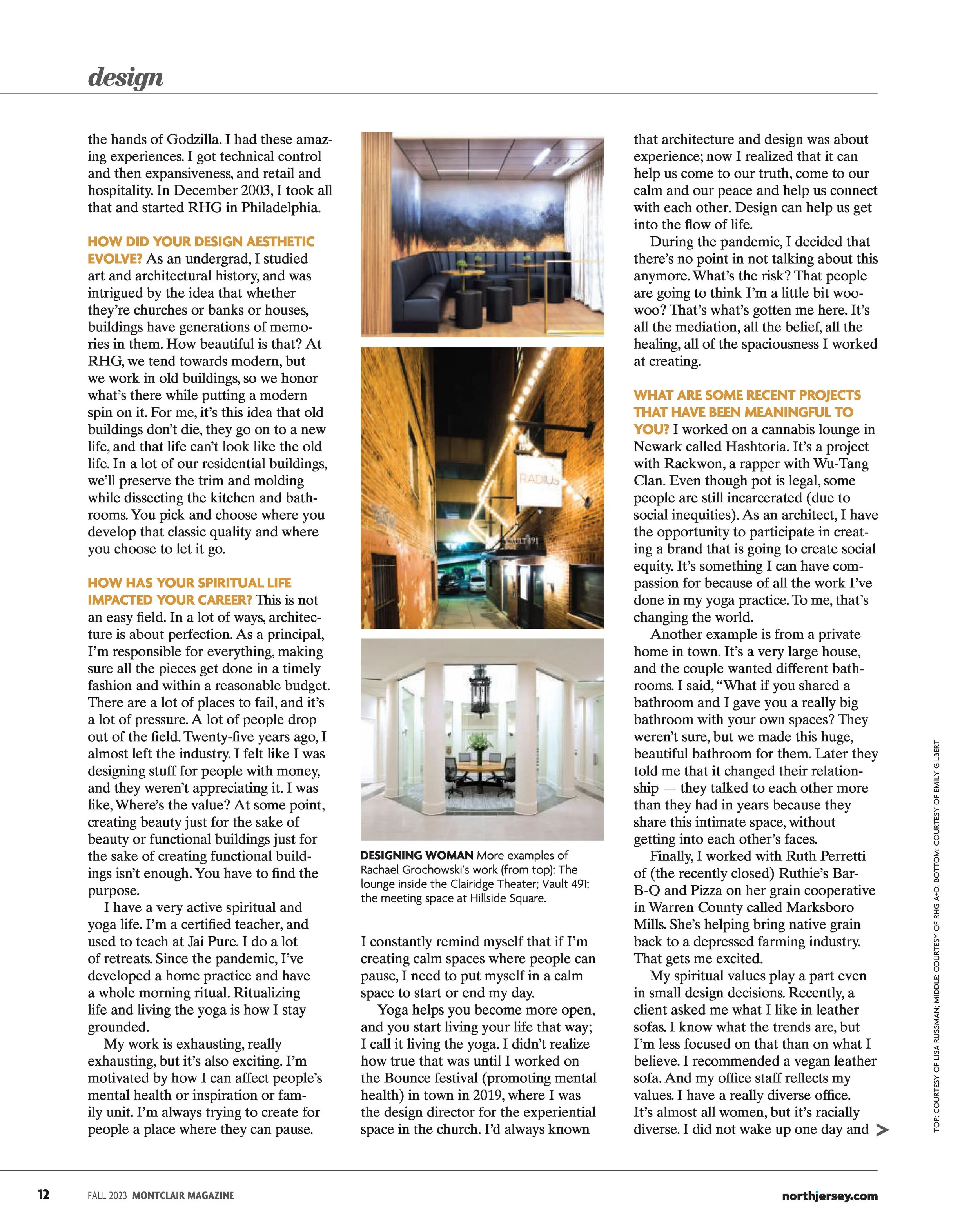
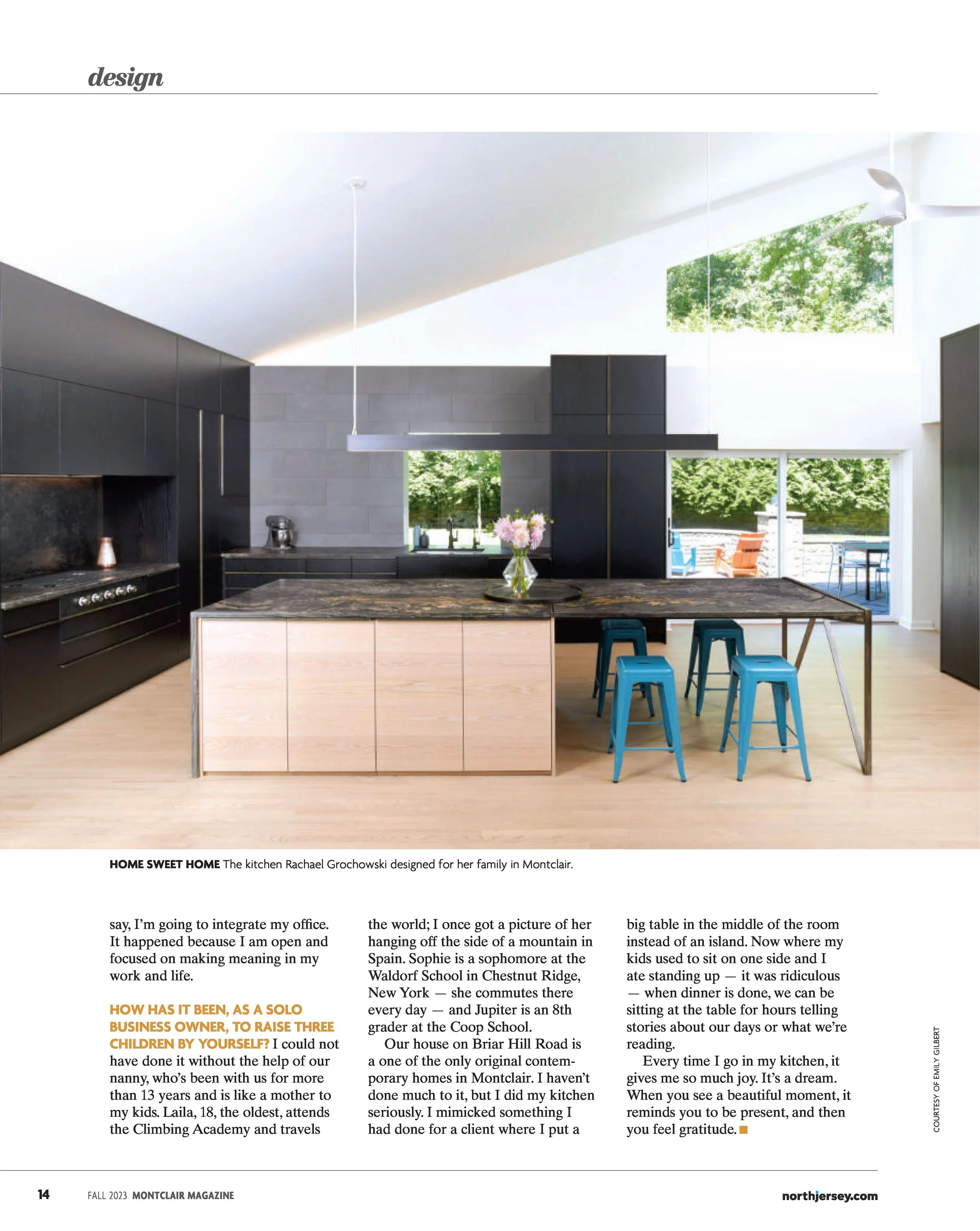
Rachael Grochowski,the architect behind RHG Architecture + Design, has her finger prints all over town: On The Clairidge Theater (where new seats were installed in time for this year’s festival), Montclair Film headquarters, The Madison Building, Vault 491, Hillside Square, Academy Square, and more restaurants, shops and homes than she can list from memory.Her influence on local design is pervasive, but it is also collaborative. She teaches her staff of 17 architects and designers skill sets for working on interiors, exteriors, commercial and private spaces, so they, and the company, can be resilient. It’s a holistic approach that has helped Grochowski thrive in her business and personal life, as she’s navigated the ups and downs of the economy and raised three children as a single mom. In advance of the Montclair Film Festival, Montclair Magazine had a wide-ranging conversation with her in her sunny, chic offices in the 491Vault building across from The Clairidge, which her firm thoroughly renovated and she oversaw the interior redesign. She talked about the evolution of her design sensibilities, how scoring an early job with developer Bob Silver jump-started her Montclair business, and what keeps her going when things get tough.HOW DID YOU BREAK THROUGH AS A YOUNG ARCHITECT IN MONTCLAIR?I moved to Montclair in 2006, but my jobs were mostly in New York City and Philly. In 2011, I decided to get an office in town, so I called Bob Silver, who had an open space in the Academy Square building. (Silver is a former president and CEO of UBS Financial Services and founder of the Bravitas Group, a commercial real estate development and management company.) Bob said the space wouldn’t work for me and suggested the adjacent former church building. It didn’t fit my budget or timeline, but I gave him my marketing package and told him,“Your buildings are beautiful, but they can be more beautiful.” I basically said,“I can do better.” He was like, yeah, yeah, no thanks. But he gave my name to the owners of the former church, since they needed a designer.They hired me, and Bob got jealous. He called me and said, “Maybe you could give me a proposal just to do the hallways and the conference room of Academy Square — that’s it.” I did that work and then he was like, “Maybe you could give me a proposal for….”We have been together ever since. RHG has done the interiors on his house and all his commercial buildings and many of his tenant spaces.We did Montclair Film’s 505 (Bloomfield Ave.) building together; RHG did the interior design, Sionas Architecture did the structure and we collaborated on the facade. That relationship with Bob has been one of the biggest gifts.WHERE DID YOUR JOURNEY IN ARCHITECTURE BEGIN?My roots are Midwestern. I grew up in Denver, went to college in Wisconsin, got my architecture degree in Milwaukee, and started my career in Chicago in 1993. Chicago is the seat of American architecture; the way they work is much different than how we work here, but it was a great foundation. I came to New York in ‘98 to see how deep I could dive into design. I’d been moonlighting for Jordan Mozer, who encouraged me as I found my way in New York. My first project was Cartier on Fifth Avenue. How lucky do you get? I also worked for Russell Groves, who was very much about high-end retail — Armani, Coach and the Greenhouse Spa, a 20-room spa on Fifth Avenue. Jordan was outward thinking, while Russell was about control, coloring within the lines, so I got to experience different approaches. Then I was with (Shogo) Aratani, who was the foremost designer in the world at the time. Mozer and Aratani were both (about) “How crazy can you make it?” I worked on the Shangri-La in Kuala Lumpur and a sushi restaurant in Turkey called Godzilla where everything was oversized, as if you were in the hands of Godzilla. I had these amaz ing experiences. I got technical control and then expansiveness, and retail and hospitality. In December 2003, I took all that and started RHG in Philadelphia.HOW DID YOUR DESIGN AESTHETIC EVOLVE?As an undergrad, I studied art and architectural history, and was intrigued by the idea that whether they’re churches or banks or houses, buildings have generations of memories in them. How beautiful is that? At RHG, we tend towards modern, but we work in old buildings, so we honor what’s there while putting a modern spin on it. For me, it’s this idea that old buildings don’t die, they go on to a new life, and that life can’t look like the old life. In a lot of our residential buildings,we’ll preserve the trim and molding while dissecting the kitchen and bathrooms. You pick and choose where you develop that classic quality and where you choose to let it go.HOW HAS YOUR SPIRITUAL LIFE IMPACTED YOUR CAREER?This is not an easy field. In a lot of ways, architecture is about perfection. As a principal, I’m responsible for everything, making sure all the pieces get done in a timely fashion and within a reasonable budget. There are a lot of places to fail, and it’s a lot of pressure.A lot of people dropout of the field.Twenty-five years ago, I almost left the industry. I felt like I was designing stuff for people with money, and they weren’t appreciating it. I was like,Where’s the value? At some point, creating beauty just for the sake of beauty or functional buildings just for the sake of creating functional buildings isn’t enough. You have to find the purpose. I have a very active spiritual and yoga life. I’m a certified teacher, and used to teach at Jai Pure. I do a lot of retreats. Since the pandemic, I’ve developed a home practice and have a whole morning ritual. Ritualizing life and living the yoga is how I stay grounded.My work is exhausting, really exhausting, but it’s also exciting. I’m motivated by how I can affect people’s mental health or inspiration or family unit. I’m always trying to create for people a place where they can pause. I constantly remind myself that if I’m creating calm spaces where people can pause, I need to put myself in a calm space to start or end my day.Yoga helps you become more open, and you start living your life that way; I call it living the yoga. I didn’t realize how true that was until I worked on the Bounce festival (promoting mental health) in town in 2019, where I was the design director for the experiential space in the church. I’d always known that architecture and design was about experience; now I realized that it can help us come to our truth, come to our calm and our peace and help us connect with each other. Design can help us get into the flow of life. During the pandemic, I decided that there’s no point in not talking about this anymore. What’s the risk? That people are going to think I’m a little bit woo-woo? That’s what’s gotten me here. It’s all the mediation, all the belief, all the healing, all of the spaciousness I worked at creating.WHAT ARE SOME RECENT PROJECTS THAT HAVE BEEN MEANINGFUL TO YOU?I worked on a cannabis lounge in Newark called Hashtoria. It’s a project with Raekwon, a rapper with Wu-Tang Clan. Even though pot is legal, some people are still incarcerated (due to social inequities). As an architect, I have the opportunity to participate in creating a brand that is going to create social equity. It’s something I can have compassion for because of all the work I’ve done in my yoga practice. To me, that’s changing the world.Another example is from a private home in town. It’s a very large house, and the couple wanted different bathrooms. I said, “What if you shared a bathroom and I gave you a really big bathroom with your own spaces? They weren’t sure, but we made this huge, beautiful bathroom for them. Later they told me that it changed their relationship — they talked to each other more than they had in years because they share this intimate space, without getting into each other’s faces.Finally, I worked with Ruth Perretti of (the recently closed) Ruthie’s Bar- B-Q and Pizza on her grain cooperative in Warren County called Marksboro Mills. She’s helping bring native grain back to a depressed farming industry. That gets me excited. My spiritual values play a part even in small design decisions. Recently, a client asked me what I like in leather sofas. I know what the trends are, but I’m less focused on that than on what I believe. I recommended a vegan leather sofa. And my office staff reflects my values. I have a really diverse office. It’s almost all women, but it’s raciallydiverse. I did not wake up one day and say, I’m going to integrate my office. It happened because I am open and focused on making meaning in my work and life.Our house is a one of the only original contemporary homes in Montclair. I haven’t done much to it, but I did my kitchen seriously. I mimicked something Ihad done for a client where I put a big table in the middle of the room instead of an island. Now where my kids used to sit on one side and I ate standing up — it was ridiculous— when dinner is done, we can be sitting at the table for hours telling stories about our days or what we’re reading. Every time I go in my kitchen, it gives me so much joy. It’s a dream. When you see a beautiful moment, itreminds you to be present, and then you feel gratitude.■ JULIA MARTIN